Monday, 11 May 2009

Group project - Developing the Idea

After deciding on using the World War II idea, we knew we had a pitch coming up soon. We had to research, and bring together ideas that would make our pitch boast a strong and professional structure. So as a group we researched and brain-stormed to create some good ideas, that would result in a “yes”, at the end of our pitch, while at the same time, executing the pitch in the correct fashion.


So, the first task was to look for contributors, without these, the project would be a “no-go”, and we surely wouldn’t progress on to create the documentary, as contributors are an essential cog in making a documentary function. I had some relatives that would make great contributors, as each have a different background, but to get the real experience of making a documentary, we also needed to venture into the outside world, meeting new people and potential interviewees, to get the proper “out in the field” experience of making a documentary.


So, what was it about my relatives that made them good contributors? The first of them, Ruby West, lived in the country capital, London, and was 16 when the war began, and lived as a civilian during this time. She encountered bomb threats, and the general day to day war life. When she turned 19, she became part of the women’s land army, and has vivid memories of this also.


Another contributor in my family was Jean smith, a civilian during the Second World War, living in the only part of Britain that was taken by the Germans; the British channels islands, specifically Jersey, where she is from. This gave us an inside look on what it was like to be occupied by the enemy during this time.


One other contributor was a local elderly neighbour who served in the RAF and always enjoys sharing his stories from his time during WWII. Someone who enjoys voluntarily speaking of the object would make for a good contributor, and also displays a different background to the previous possible contributors, adding different angles and lifestyles between people who lived through this time period.


Then, through research, we discovered two locations, where we may be able to find available contributors. The first location we came across was Somerset Legion House on Weston-super-Mare's seafront, “Which offers members of the armed forces a place to relax and, talk to people who understand what they've been through”.


It states that it is for “Service men and women across the country”, which offers gender differentiation for our interviews. It also boasts that; “Somerset Legion House is a haven of a retreat.” They take in people who served in the forces (not just during WWII) from all over the United Kingdom. We took the contact details, and managed to arrange filming dates over the phone, for the Easter holidays. We also met up personally with the staff, who work there, to confirm and address them further of our intentions.


The second location was Flowerdown house, conveniently located, opposite, and about 10 yards from the Somerset Legion House. Flowerdown House interested us, describing itself as a “Residential care home scheme is managed by Royal air forces association. Flowerdown house provides short welfare breaks for the RAF family”. We agreed this was another good location, which welcomed both men and women of the RAF and WAAF of the United Kingdom. Once again we gained contact details, and arranged dates within the Easter holidays also.


We repeated our act of visiting the staff in person, and informing them on the whole process. After visiting both locations in person, we gained feedback from the staff, telling us, that the occupants were very willing, and happy to undergo our interviews for the dates negotiated. Release forms and location filming forms will need to be created for these events to be legally usable for our project.

Group Project - Getting Ideas

Today we all had to discuss what topic we wanted to centre our group project on. The group project had to be a factual documentary where all three of us had to share equal measures in all aspects of making the documentary. The people in my group consist of Daniel Crosfield and Monish Kelly. So what subject were we going to choose? It was a tough ordeal and took us a lot of time to finalise our decision.


We came up with a few ideas first. Our first idea was based on documenting staff working at a local zoo, giving an overview of the day to say life and events within the zoo. It wasn’t a bad idea, but we thought it didn’t have much of a hook that would grab audience’s attention.


We then channelled our thoughts to a second idea, one of which we gained two possible subjects for our documentary. We thought about doing a documentary to do with local crime, making a documentary local and topical, would boost the interest of the program for viewers. We targeted either youth crime or anti-social behaviour when the night clubs close.


On thinking through this second, idea we came across many flaws in executing this as our subject. The first would be the hunt for contributors, we couldn’t guarantee contributors and they would have to be found on the spot. If we documented an interview with no video evidence of them committing a crime, the information they provide may not be true. Also contributors may not be willing to be documented, as this documentary could be perceived as a “name and shame” scenario. Also for youth, parent’s permission would be required, to acquire consent, and parents wouldn’t necessarily want their children being portrayed as a criminal.



Another idea we stumbled upon was a sports themed idea, the local football team, Weston-super-Mare FC, battling relegation at the bottom of their league, is gave a good hook for viewers, but players would not be willing to take part in an interview focusing on how bad they are playing, as opposed to documenting them battling for the top-spot in their league.


Then the Idea that we chose after much discussion, came with many additions that shine above are other ideas, such as: a good hook, universal age interest, local (UK), moving and willing contributors were much easier to come by.


The idea was to film a World War II documentary, comprised of interviews visiting the memories of WWII survivors, consisting of people that were among the many forces that fought during the time, and also the voices of civilians that lived through that time. This is a good idea as all ages are interested in WWII, contributors are more willing to be interviewed, and other factors that we will highlight in our development of the idea, and the pitch coming in the near future.

Friday, 16 January 2009

Evaluation of the year (Oct 08' - Jan 09')

I have learnt a lot since i started the course in October 2008. One thing that was interesting is that i was never interested or had any intention of working to sound, but these last few months have been all about sound, and i have thoroughly enjoyed it. I learnt about all the physics and how sound works, different types of microphones and when to use them. I also am now able to use a new piece of software (Pro tools LE) and how to understand sound waves and patterns in order to edit them easier. 


I also gathered a lot of vox pops during the course so far, i don't have a lot of confidence and never thought i would be able to cope with it well. It was a situation that i would have never undergone if i didn't take the course. I am capable of gathering vox pops now, and although still a little shy to the matter, my confidence has gone up from doing this. This task of gathering vox pops, along with interview, required using new hardware which i had not come across before the course. I learnt how to used the Fostex recorder and the mini disc recorder, and am very comfortable on how to use them, and which piece of equipment is best for which situation.

I got to meet two people also during the course, which i found very interesting. One of these individuals was radio presenter Ian downs. He was able to give us his life story of how he got into radio, what things he would have to come across in the industry, some useful tips and why he has now chosen to be a freelancer. We also met documentary director Tom cholmondeley, who gave us the ins-and-outs of what it is like to be a director, how he got to his current role, and some more useful tips. Both Ian and Tom had to undergo an interview from us, which we had to edit and use in our module.


I also learnt what a soundscape was, how, why and where it used. I learnt what makes a good soundscape, and that it is a lot more complicated than it sounds. I enjoyed making my soundscape and found it very interesting as a whole, and wouldn't mind doing more of this in the future.


Another thing i learnt was how to get into the industry, how to work your way up, and also what each job requires. I am still unsure of what job i would wish to take in the future, but my ideas have been narrowed down to a few roles because of this. Making the radio program was both fun, and using role allocations while producing it was beneficial, e.g. i was the producer. We also had to research and present our ideas to a "acting panel", to get permission to make the program, which was daunting but realistic and helpful. I also picked up how a radio should be structured, and was one half of the presenters within the show, which i actually quite enjoyed surprisingly. 


All together it was a very enjoyable and interesting year, and have gained a lot from doing the course, so much that i wish it was a 5 day a week course sometimes. I have appreciated the fact that it has introduced me to things i wouldn't usually have thought about, and has given me a better insight to the industry and how it works.

Thursday, 15 January 2009

ASA


The ASA (Advertising Standards Authority) is the independent body set up by the advertising industry to police the rules laid down in the advertising codes. The strength of the self-regulatory system lies in both the independence of the ASA and the support and commitment of the advertising industry, through the committee of advertising practice (CAP), to the standards of the codes, protecting consumers and creating a level playing field for advertisers.


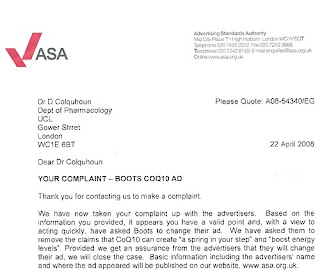
ASA can stop misleading, harmful or offensive advertising. ASA can ensure sales promotions are run fairly. They can help reduce unwanted commercial mail, either sent through by the post, by e-mail or text message, and can resolve problems with mail order purchases.


The ASA investigates complaints made about adverts, sales promotions or direct marketing. Anyone has the right to complain to the ASA. Most complaints are made through the complaints form on their website. ASA publish their adjudications on complaints on their website every wednesday.


ASA research into many areas to help with their work, including research into people's attitudes towards advertising and compliance with the advertising standards codes within specific sectors and media.


The Advertising standard codes are separated out into codes for TV, radio and all other types of ads. There are also rules for teletext ads, interactive ads and the scheduling of television ads. The main principles of the advertising standards codes are that ads should not mislead, cause harm, or offend.


Wednesday, 14 January 2009

BBC organisation + Copyright and creative commons.

The BBC (British broadcasting company) is the largest broadcasting corporation in the world. It's mission is to enrich peoples lives with programmes that inform, educate and entertain. It is a public service broadcaster, established by a Royal Charter and funded by the license fee that is paid by UK households. 


The BBC uses income from the license to provide services including 8 national TV channels plus regional programming, 10 national radio stations, 40 local radio stations and an extensive bbc.co.uk website. BBC world service broadcasts to the world on radio, on TV and online. Providing news and information in 32 languages. It is funded by a government grant, not from the license fee.


The BBC has a commercial arm, BBC Worldwide, which operates a range of businesses including selling programmes around the world and publishing books, DVD and merchandise. Its profits are returned to the BBC for investment in new programming and services. The BBC is governed by the BBC trust, which represents the interests of license fee payers and sets the overall strategy. The Trust's chariman is Sir Michael Lyons. The BBC's Executive board, chaired by the Director-General, Mark Thompson, manages the day-to-day operation of the corporation.


For the BBC's health and safety regulations click here

COPYRIGHT


The law governing copyright in the UK is the Copyright Design and Patents Act (CDPA)(1988) and amendments. It exists to protect the intellectual standing and economic rights of creators and publishers of literary, dramatic, artistic, musical, audiovisual and electronic works. As long as the work is original, copyright protection is automatic. In the UK where there is no registration or other procedures to follow, copyright exists whether or not it is asserted using the copyright symbol or otherwise. The copyright symbol was established by the universal copyright convention in 1952 and when used signifies that the work is copyright protected.

CREATIVE COMMONS


Creative commons is a nonprofit corporation dedicated to making it easier for people to share and build upon the work of others, consistent with the rules of copyright. Creative commons provides free licenses and other legal tools to mark the creative work with the freedom the creator wants it to carry, so others can share, remix, use commercially, or any combination thereof. 


Tuesday, 13 January 2009

BBFC

The BBFC is the British Board of Film classification. It's main responsibility is to control the age restrictions for film within the United Kingdom.

There are currently 8 Classifications under the BBFC


Uc and U - a film classified as U or Uc is suitable for all, however a Uc is mainly targeted towards young children. Themes are usually quite sensitive, allows infrequent mild language, occasionally natural nudity but no sexual content. mild sexual behavior is acceptable e.g. kissing, mild violence only. Horror effects should be mild and brief. No reference to illegal drugs or use of illegal drugs.


PG - Parental Guidance, which means parents should watch the material beforehand and decided whether the content is suitable for their child. can have mild bad language only, natural nudity, mild sex references, moderate violence without detail, no glamorisation of realistic or easily accessible weapons. frightening sequences may not be prolonged or intense. Any drug references must carry a suitable anti drug message.


12 and 12A - suitable for viewers aged 12 and over, 12A is a film classified as "12" but is allowed to be viewed within the cinema accompanied by an adult. A person must be 12 to purchase the film on DVD, 12A is used in cinema only. Mature themes acceptable but must be suitable for young teenagers, sexual content must be brief and discreet, sexual references may be implied to that should not go beyond what is suitable for them. violence must not dwell on detail, no emphasis on injuries or blood. horror can be sustained but moderate. Drugs should be infrequent and not glamorised.


15 - is suitable only for people over the age of 15. Can contain frequent strong language e.g. "fuck" but the strongest terms such as "Cunt" will only be acceptable when justified by content. This type of language cannot be continued and aggressive. Sexual content shown but without strong detail. violence may be strong but not dwell on the infliction of pain. strong threat and menace permitted. gory images are unlikely to be acceptable. Drugs can be show but must not promote or encourage drugs.


18 - suitable only for adults. strong frequent horror, strong frequent language, sex (soft) strong maintained threat. Drugs used.


R18 - for adults only, to be shown in specially licensed cinemas or sex shops, and to adults of no less then 18 years.  


Monday, 12 January 2009

Ofcom

Office of communications, or as it is more commonly known (ofcom) is the independent regulator and competition authority for the communication industries within the United Kingdom. Ofcom was created by the communications act 2002 and was formed on the 29th of December 2003. Ofcom took responsibilities of five previous regulatory bodies.

These previous 5 bodies that made ofcom were;


Some of the main responsibilities of Ofcom are licensing, undertaking research, creating codes and policies. They also address complaints and look into competition. 

Part of Ofcom's duty is to examine complaints made by viewers or listeners. When Ofcom receive a copy of the programme they check the material to see if it breaches The Broadcasting Code. Ofcom will ask for a response from the broadcaster to the complain. Then Ofcom will deem the situation "resolved" or take further action.


Ofcom considers consultations to be a vital way of helping it to make the right decisions based upon the right evidence. Ofcom's formal process of consultation starts with document being published (which can be found on their website) asking for views and responses.


Ofcom is responsible for the management, regulation,  assignment and licensing of the UK's Electromagnetic spectrum. It Licenses for TV, radio, Mobile phone transmissions and private communications networks.  The Process of Licensing varies on the type of usage required, some licenses may simply have to be applied and paid for. Most of the procedures in place are taken for the previous 5 regulators, but Ofcom may change these procedures within  the future.

One recent issue regarding the "Russell Brand show prank telephone calls row" had to undergo regulation from Ofcom. The Show gained many complaints and was resolved by Russell Brand being suspended completely  from the BBC and Jonathan Ross suffering a 3 month suspension.

However Journalist such as Jim Black Criticised Ofcom, citing what he sees as its pandering to conformity:

"simply dispensing rules and regulations from on high, coercing and threatening people into line, makes things worse. being told how to behave is different from knowing how to behave. Indeed, it is precisely the experience of stifling conformism promoted by outfits like Ofcom that can lead to the comic tourettes offered by the likes of Ross and Brand.